What your HbA1c means
HbA1c is the single most important number for understanding blood sugar over time — it's what doctors use to screen for and manage prediabetes and diabetes. Here's what it actually measures, the ranges that matter, what it maps to in everyday blood-sugar terms, what can throw it off, and why the trend across tests is the part to watch.
Quick reference: for the typical range at a glance, see HbA1c in our blood test results library, or browse every common marker and its normal range.
This is general educational information, not medical advice. Diagnosis and treatment of diabetes are clinical decisions — discuss your results with a healthcare professional.
What HbA1c measures
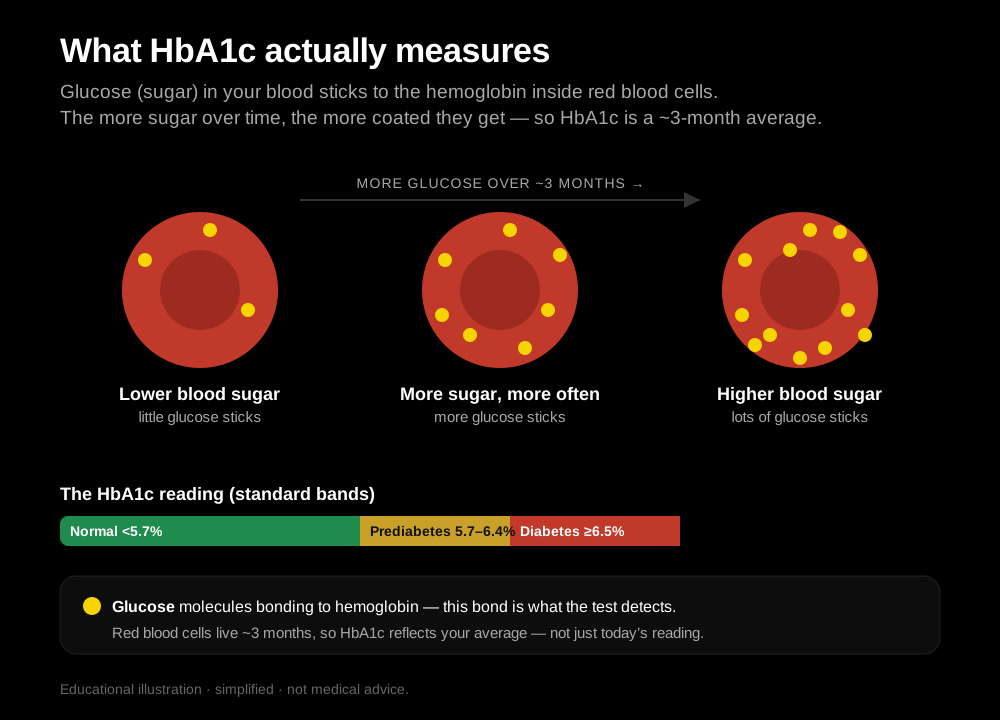
When glucose is in your blood, some of it sticks to hemoglobin in your red blood cells. Because those cells live about 2–3 months, the percentage of "glycated" hemoglobin — your HbA1c — reflects your average blood sugar over that window. That makes it more stable and informative than a one-off fasting glucose, which only captures a single moment.
You'll see this test under several names — A1C, HbA1c, HgbA1c, or glycated hemoglobin (UK spelling glycated or glycosylated haemoglobin). They all refer to the same measurement.
One practical consequence of the 2–3 month window: the most recent few weeks weigh more heavily than the beginning of the window. Roughly speaking, the last month contributes about half the result and the two months before that the other half. That's why a very recent change in blood sugar — a stressful illness, a new medication, a holiday of heavy eating — can start to nudge the number before a full three months have passed, and why HbA1c is a smoothed picture rather than a snapshot of any single day.
What your HbA1c means in everyday blood sugar (eAG)
A percentage doesn't intuitively translate to what a glucose meter shows, so labs and clinicians often convert HbA1c into an estimated average glucose (eAG) — the same units you'd see on a fingerstick or continuous monitor. It's a modeled average derived from your HbA1c, not a reading of your blood at any one moment.
| HbA1c (%) | HbA1c (mmol/mol) | eAG (mg/dL) | eAG (mmol/L) |
|---|---|---|---|
| 5.0% | 31 | ~97 | ~5.4 |
| 5.7% | 39 | ~117 | ~6.5 |
| 6.0% | 42 | ~126 | ~7.0 |
| 6.5% | 48 | ~140 | ~7.8 |
| 7.0% | 53 | ~154 | ~8.6 |
| 8.0% | 64 | ~183 | ~10.2 |
A rough rule of thumb: each 1% rise in HbA1c is about 28–29 mg/dL (roughly 1.6 mmol/L) more average glucose. Two cautions worth keeping in mind. First, eAG is an average — it says nothing about how much your glucose swings above and below that line, which is why two people with the same HbA1c can have very different day-to-day patterns. Second, some people are "high glycators" or "low glycators": their red cells glycate glucose a little faster or slower than the model assumes, so their real average glucose sits somewhat above or below the eAG. If you use a glucose meter or continuous sensor, comparing your own measured average against your eAG over time is the most reliable way to know which side of the model you fall on. To move between mg/dL and mmol/L, our HbA1c and blood-unit converter does the math.
The ranges that matter
| HbA1c (%) | HbA1c (mmol/mol) | Category |
|---|---|---|
| Below 5.7% | Below 39 | Normal |
| 5.7–6.4% | 39–47 | Prediabetes |
| 6.5% and above | 48+ | Diabetes (confirmed on two tests) |
For many people already managing diabetes, a common target is below 7%, but individual targets vary — your clinician sets yours based on age, health, and risk.
The same result is reported in two units: % (NGSP), common in the US, and mmol/mol (IFCC), standard in the UK and much of the world. They're interchangeable — so the diabetes threshold of 6.5% is the same as 48 mmol/mol, and a normal reading sits below 5.7% (39 mmol/mol). If your report shows a number like "48 mmol/mol," read it against the mmol/mol column above. Need to switch units? Use our free HbA1c and blood-unit converter. To see your A1c as an everyday glucose number, our A1c to average glucose (eAG) calculator converts it both ways.
It's worth stressing why the diabetes diagnosis requires two tests (unless blood sugar is unmistakably high with clear symptoms). A single HbA1c can be thrown off by the red-cell factors below, or simply sit a hair over the line by chance. Repeating it — or confirming with a different test on a separate day — protects against labeling someone based on one borderline value.
Because HbA1c is a window into metabolic health, it often moves alongside other metabolic markers — non-alcoholic fatty liver disease, for instance, tracks closely with blood sugar and is a frequent reason for elevated liver enzymes on the same panel. The same metabolic stress also tends to nudge inflammation up, which is why a mildly elevated hs-CRP often travels with creeping blood sugar.
Why targets are individual
The "below 7%" figure is a common starting point, not a universal goal. Guidelines describe it as a target that should be personalized, and clinicians routinely aim higher or lower depending on the person:
- A tighter target (for some, closer to the normal range) may suit a younger person, someone recently diagnosed, or anyone who can reach it without frequent low blood sugar. The rationale is that years of near-normal glucose lower the long-term risk of complications in the eyes, kidneys, and nerves.
- A looser target may be safer for an older adult, someone with several other health conditions, a limited life expectancy, or a history of severe hypoglycemia (dangerously low blood sugar). Here, pushing HbA1c down aggressively can cause more harm than the number itself is worth.
The recurring theme is that the risk of low blood sugar often decides how tight a target can safely be. A person on insulin or certain other medications who drops too low is at immediate risk; a person managing blood sugar through lifestyle alone generally is not. This is exactly the kind of trade-off a clinician weighs with you, and it's why comparing your target to someone else's rarely makes sense.
What can affect or distort it
HbA1c relies on normal red blood cells living a normal lifespan, so anything that changes them can skew the result. The key idea: conditions that make red cells live longer tend to raise HbA1c (more time to accumulate glucose), while conditions that make them live shorter or turn over faster tend to lower it.
Things that can make HbA1c read falsely high:
- Iron-deficiency anemia and vitamin B12 or folate deficiency, which slow red-cell turnover so cells circulate longer
- Advanced kidney disease and its treatments, which can push the result in either direction depending on the situation
- Certain hemoglobin variants, which interfere with some laboratory assays and can produce spuriously high (or low) numbers depending on the method
Things that can make HbA1c read falsely low:
- Recent blood loss, hemolytic anemia, or a recent transfusion, because younger replacement cells haven't had time to glycate
- Pregnancy, especially the second and third trimesters, when red-cell turnover speeds up — one reason pregnancy diabetes is diagnosed with glucose testing rather than HbA1c
- Conditions that shorten red-cell survival, including some inherited disorders and an enlarged spleen
If your HbA1c doesn't fit your other numbers — a normal HbA1c with clearly high fasting glucose, say, or the reverse — this mismatch is often the reason. A clinician who suspects it may switch to fasting glucose or an oral glucose tolerance test, both of which measure glucose directly and don't depend on red-cell lifespan. Laboratories can also use hemoglobin-variant-tolerant methods when a variant is known.
How it fits with fasting glucose and the OGTT
HbA1c is one of three common ways to look at blood sugar, and they answer slightly different questions — which is why clinicians sometimes use them together rather than choosing one:
- Fasting glucose is a single measurement after not eating overnight. It's cheap, quick, and captures your baseline first thing in the morning — but it's a snapshot, sensitive to what you did the day before, and it can miss problems that only show up after meals.
- HbA1c is the 2–3 month average. It needs no fasting and doesn't care about yesterday's dinner, which makes it convenient and stable — but it can smooth over meaningful post-meal spikes and, as above, be distorted by red-cell conditions.
- The oral glucose tolerance test (OGTT) measures blood sugar before and two hours after a standardized sugary drink. It's the most sensitive of the three for catching early or after-meal glucose problems, so it's used when other tests are borderline or when the situation demands sensitivity — most notably in pregnancy. Its downside is that it takes a couple of hours and requires the drink.
No single test is "best." When results agree, you can be confident. When they disagree, the disagreement itself is useful information, and each test's blind spots help explain the others. Seeing them side by side is part of how to read your blood test results rather than reading any one number in isolation.
What usually happens after a high result
A first HbA1c in the prediabetes or diabetes range is a starting point, not a verdict, and it helps to know the typical path so the number feels less alarming:
- Confirmation. For a result at or above 6.5%, a clinician generally repeats the test (or confirms with fasting glucose or an OGTT) on a separate day before making a diagnosis — unless blood sugar is very high with clear symptoms.
- Context. Your clinician will look at the whole picture: weight, blood pressure, cholesterol, family history, medications, and any symptoms. HbA1c rarely travels alone; it's usually read alongside the rest of a metabolic panel.
- A plan. For prediabetes, the first step is frequently a structured lifestyle effort, because it's often enough to move the number back down. For diabetes, the plan may add medication. Either way, a re-test in roughly three months is common — long enough for the average to reflect any changes.
Prediabetes in particular is often reversible when caught early, which is much of the reason screening exists.
Lifestyle levers that move it
Because HbA1c is an average of everyday blood sugar, the things that lower it are the ordinary levers of metabolic health — nothing exotic, and worth discussing with a clinician before making big changes, especially if you take glucose-lowering medication:
- Losing excess weight. Even modest weight loss can meaningfully improve blood sugar for many people carrying extra weight.
- Moving regularly. Both aerobic activity and muscle-building help, and a short walk after meals blunts the post-meal glucose rise that feeds into HbA1c.
- Adjusting what and how you eat. Cutting back on refined carbohydrates and sugary drinks, and favoring fiber, protein, and whole foods, tends to flatten the spikes the test averages.
- Sleep and stress. Poor sleep and chronic stress raise blood sugar through hormonal pathways; improving them can help.
- Not smoking. Smoking is linked to worse blood-sugar control and higher diabetes risk.
The important caveat is timing: because the test averages 2–3 months, changes you make today won't fully show up until roughly a full cycle later. Give a change a complete window before re-testing — checking again in three weeks will mostly show noise, not progress.
Why the trend matters
Because HbA1c is already a 2–3 month average, the direction across several tests is the real signal. A move from 6.1% to 5.7% after diet and activity changes is meaningful progress you'd miss looking at one value. It also puts a single borderline reading in perspective: one number a touch over a threshold means far less than a steady climb across three checks. Seeing it plotted alongside your weight, activity, and other labs is exactly the kind of connected view that's hard to get from scattered PDFs — see tracking lab results over time and how to read your blood test results.
When to talk to a doctor
Any HbA1c in the prediabetes range or above warrants a conversation with a clinician about next steps — and the good news is that prediabetes is often reversible with changes caught early. It's also worth raising if your HbA1c doesn't square with your other results or your symptoms, since that mismatch may point to one of the red-cell factors above and change which test is right for you. For more on understanding your panels, browse the rest of the Quanome blog.
Track your HbA1c over time, privately
Quanome pulls your lab results into one private timeline and tracks them over time — on your device, never uploaded. Learn more about Quanome →


Frequently asked questions
What does HbA1c measure?
HbA1c (glycated hemoglobin) reflects your average blood sugar over roughly the past 2–3 months, because glucose attaches to hemoglobin in your red blood cells over their lifespan. It's a longer-term view than a single fasting glucose reading.
What are the HbA1c ranges?
Standard thresholds: below 5.7% is normal, 5.7–6.4% is prediabetes, and 6.5% or higher (on two tests) indicates diabetes. In mmol/mol that's below 39, 39–47, and 48+.
What can falsely affect HbA1c?
Conditions affecting red blood cells — anemia, recent blood loss, certain hemoglobin variants, pregnancy, and advanced kidney disease — can make HbA1c read falsely high or low. In those cases clinicians may rely on other measures like fasting glucose or a glucose tolerance test.
Why track HbA1c over time?
Because it's a 2–3 month average, the trend across several tests shows whether lifestyle changes or treatment are working far better than any single value. A drop from 6.0% to 5.6% over two checks is a real signal.
Is HbA1c the same as A1C or glycated haemoglobin?
Yes — A1C, HbA1c, HgbA1c, and glycated (or glycosylated) haemoglobin are all names for the same test. The British spelling is 'haemoglobin', the American is 'hemoglobin'. It measures the same thing: your average blood sugar over roughly 2–3 months.
What is 48 mmol/mol, and what is a normal HbA1c in mmol/mol?
mmol/mol (IFCC) is the unit used in the UK and most of the world; the US uses %. Normal is below 39 mmol/mol (5.7%), prediabetes is 39–47 mmol/mol (5.7–6.4%), and 48 mmol/mol (6.5%) or above indicates diabetes. So 48 mmol/mol is exactly the diabetes threshold.
What average blood sugar does my HbA1c correspond to?
Roughly: 5.7% (39 mmol/mol) maps to an estimated average glucose (eAG) near 117 mg/dL (6.5 mmol/L); 6.5% (48 mmol/mol) to about 140 mg/dL (7.8 mmol/L); and 7% (53 mmol/mol) to about 154 mg/dL (8.6 mmol/L). eAG is a modeled average, not a spot reading, and individual glucose can differ from the model.
How often should HbA1c be checked?
It varies by situation. For screening in someone without diabetes, a clinician might repeat it every 1–3 years, sooner if you're in the prediabetes range. For people managing diabetes it's often checked every 3–6 months. Because red cells turn over across 2–3 months, testing much more often than every three months usually adds little. Your clinician sets the interval.
Can HbA1c be normal but I still have a blood sugar problem?
Sometimes. HbA1c can miss post-meal spikes or early glucose problems, and conditions that shorten red-cell life can pull it down toward normal. If your fasting glucose, symptoms, or risk factors don't fit a normal HbA1c, a clinician may add a fasting glucose or oral glucose tolerance test.
What lifestyle changes tend to lower HbA1c?
The usual levers are the same ones that improve blood sugar generally: losing excess weight, regular activity (including muscle-building and post-meal walks), cutting back on refined carbohydrates and sugary drinks, better sleep, and not smoking. Effects show up gradually over the 2–3 month window the test averages, so give changes a full cycle before re-testing.
Quanome is live — free on iPhone and Android
Make sense of your DNA and health data privately. Download Quanome free on the App Store or Google Play.
Quanome is free on the App Store and Google Play. Want product news too? Leave your email below.